What You Should Know Before You Start Shopping for a Home in Canada
Six things to settle before you open a single listing plus the two Canadian rules (the stress test and closing-cost cash) most checklists get wrong.
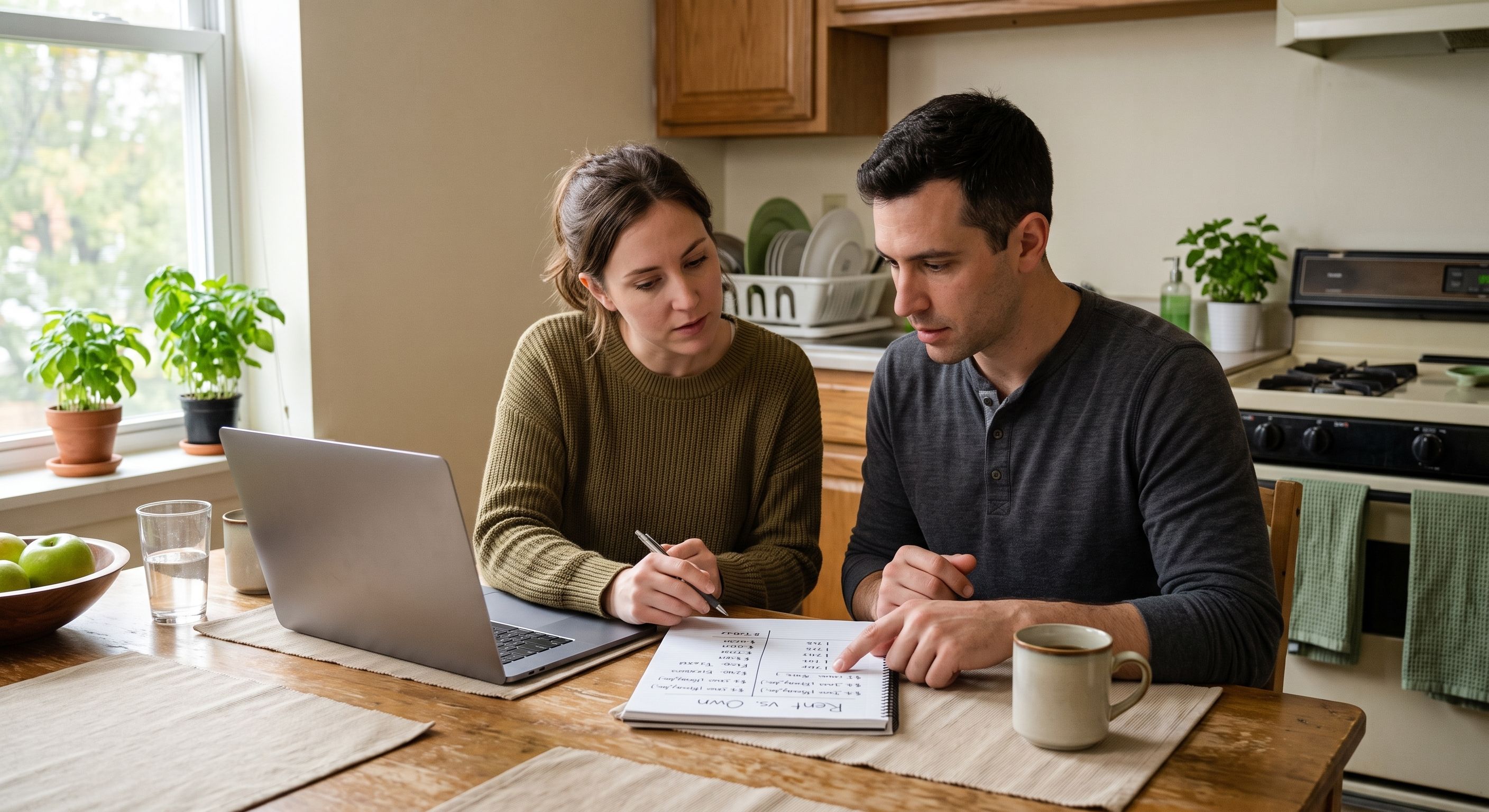
The six things to settle before you open a single listing and the two Canadian rules most checklists get wrong
Quick answer
Before you start shopping for a home in Canada, settle six things: the type of home you want, your must-have features, the mortgage amount you qualify for at the stress-test rate, your total monthly housing cost, and your down payment and closing costs as two separate cash requirements then bring in a real estate agent.
Canadian lenders use GDS and TDS ratios, capped around 39% and 44% on an insured mortgage, calculated at the higher of your contract rate plus 2% or 5.25%.
Why the American checklist will cost you money here
Most of the home-buying checklists that surface in a search are written for a U.S. audience. They tell you to plan on 3.5% down, to keep housing costs under 25–28% of gross income, and to budget 2–5% for closing costs.
Every one of those numbers is wrong in Canada.
Our minimum down payment is tiered and rises with the price. Our lenders test you at a rate you won't actually pay. Our closing costs vary enormously between Ontario and Alberta because one province charges land transfer tax and the other doesn't. And our qualifying ratios are different numbers entirely.
Here's the Canadian version.
1. What type of home are you actually buying?
In Canada the ownership structure matters as much as the building, because it changes what you can borrow and what your monthly cost really is.
| Home type | What you own | What lenders should know |
|---|---|---|
| Detached | The house and the land | Straightforward financing; usually the highest price point |
| Semi-detached | Your half and its land | Financed the same as detached |
| Freehold townhouse | The unit and the land under it | Sometimes carries a small common-element fee — ask |
| Condo townhouse / condo apartment | Your unit plus a share of common elements | 50% of your condo fee counts against your GDS ratio; a weak reserve fund can affect approval |
| Co-operative (co-op) | Shares in a corporation, plus the right to occupy | The hard one. You aren't on title, so most big banks won't lend. Financing usually means a credit union share loan, a larger down payment, and no default insurance |
| Duplex / home with a legal secondary suite | The property, plus rental income | A portion of documented rent can help you qualify but the suite generally has to be legal and the income provable |
The practical filter: if a property type is hard to finance, it is also hard to refinance and hard to sell. If you expect your circumstances to change in the next few years, buy something a lender will happily lend against.
2. What features do you actually need?
Write two lists before you look at anything: must-have and nice-to-have. Then be honest about which list "finished basement" belongs on.
Three things belong on the must-have list more often than buyers realize:
3. How much mortgage do you actually qualify for?
This is where the American figure does the most damage. Canada does not use a 25–28% housing ratio. Canadian lenders use two ratios:
Both are calculated at the stress test rate: the higher of your contract rate plus two percentage points, or the 5.25% floor. You qualify at that rate even though you'll pay the lower one.
Many banks apply tighter internal limits than the insured maximums, closer to 32% GDS and 40% TDS — so "the rules allow 39%" and "this bank will approve 39%" are two different sentences.
The fast sanity check: annual household income × 4.5, plus your down payment, is a reasonable first estimate of your maximum purchase price. It is not an approval. Get a real pre-approval before you shop, and get the number in writing.
4. What will the home actually cost you every month?
Your mortgage payment is not your housing cost. Lenders look at PITH: Principal, Interest, Taxes, and Heat plus half your condo fee if you have a condo and have to pay this.
On a $650,000 home, the pieces you have to add on top of principal and interest usually include:
5. Down payment and closing costs are two separate requirements
This is the single most expensive misunderstanding in Canadian home buying, and it is the reason families who have saved diligently still get declined.
Your minimum down payment is tiered
| Purchase price | Minimum down payment |
|---|---|
| $500,000 or less | 5% |
| $500,001 – $1,499,999 | 5% of the first $500,000 + 10% of the remainder |
| $1,500,000 and above | 20% (mortgage default insurance isn't available at all) |
On a $650,000 home that's $40,000, not $32,500. On a $700,000 home it's $45,000. The percentage quietly climbs as the price does, which means that if prices move while you're saving, your target moves with them.
With less than 20% down you also carry mortgage default insurance, which is added to your mortgage balance, except in Ontario, where the provincial sales tax on that premium is payable in cash on closing day. That surprise is worth a few thousand dollars.
Closing costs are cash, and they can't be financed
Budget 1.5% to 4% of the purchase price, in cash, on top of the down payment. What's in it:
| Closing cost | Ontario | Alberta |
|---|---|---|
| Land transfer tax | Provincial LTT, plus a second municipal LTT inside Toronto | None |
| Title / mortgage registration | Included in legal disbursements | $50 base + $5 per $5,000 of value — charged twice (transfer and mortgage) |
| Legal fees and disbursements | ~$1,500–$2,500 | ~$1,000–$2,000 |
| Title insurance | ~$300–$700 | ~$250–$500 |
| Appraisal / inspection | ~$300–$900 | ~$300–$900, plus a Real Property Report on many resales |
| Tax and utility adjustments | Variable | Variable |
| PST on default insurance | Yes, payable at closing | No |
First-time buyers in Ontario can claim a provincial land transfer tax rebate of up to $4,000, and inside Toronto an additional municipal rebate of up to $4,475. Your lawyer claims both at closing.
Alberta buyers have no land transfer tax at all, the practical difference on a mid-priced home is thousands of dollars but the land titles registration levy went up sharply in October 2024, so any calculator still showing $2 per $5,000 is out of date.
The money you're allowed to use
The FHSA lets you contribute $8,000 a year to a lifetime maximum of $40,000, deductible going in and tax-free coming out for a qualifying home. The RRSP Home Buyers' Plan allows a withdrawal of up to $60,000 per person, repayable over 15 years. You can use both on the same purchase. Gifted down payments from immediate family are accepted by most lenders with a signed gift letter.
6. Now bring in a real estate agent
Once you know your price, your cash position and your must-haves, an agent is worth their weight in gold sorting listings, reading a seller's motivation, structuring conditions, and running the offer process.
The two questions that decide whether you're actually ready
Everything above collapses into two:
If the answer to both is yes, start shopping. If the answer to either is no, you need a number and a date, not a vague "work on it and come back."
What if you don't pass yet?
There are three honest answers, and only one of them is us.
How the Clover program handles the six things above:
We turn people down. If you're eight months from qualifying, buying is cheaper than bridging, and we'll tell you so.
Frequently asked questions
How much do I need to buy a house in Canada?
On a $650,000 home: $40,000 minimum down payment plus roughly $9,750–$26,000 in closing costs depending on whether you're in Ontario or Alberta and inside Toronto or outside it. Down payment and closing costs are separate requirements and closing costs cannot be rolled into the mortgage.
What is the 28% rule in Canada?
It doesn't apply. That's an American guideline. Canadian lenders use GDS and TDS ratios — typically capped at 39% and 44% on an insured mortgage — calculated at the stress test rate rather than your actual rate.
Do I need 20% down to buy a home in Canada?
No. The minimum is 5% on the first $500,000 and 10% on the portion above that, up to $1.5 million. Below 20% down you carry mortgage default insurance, and in Ontario the PST on that premium is due in cash at closing.
Are closing costs the same in Ontario and Alberta?
No, and the difference is large. Ontario charges provincial land transfer tax, doubled inside Toronto. Alberta charges no land transfer tax — only a land titles registration levy of $50 plus $5 per $5,000 of value on the transfer and again on the mortgage.
Can I buy a home if I don't pass the mortgage stress test?
Not with a federally regulated lender today. Your options are to keep saving, to repair the specific issue holding the file back, or to use a structured bridge like rent-to-own if the realistic timeline is three to four years and you need housing stability now.
> Know your number before you start looking.
>
> ✓ A written gap: the exact dollars and months between you and an approval
>
> ✓ Down payment and closing costs itemized separately, on a real purchase price
>
> ✓ An honest answer on whether renting, repairing, or bridging is cheapest for you
>
> ✓ Serving Southwestern Ontario and Alberta, on homes from $400,000 to $900,000
>
> Book a no-obligation pre-qualification conversation to find out if rent-to-own can help you!
Sources and notes
This article is for information only and is not mortgage, legal, tax or financial advice. Program terms, deposits and equity sharing are set individually and vary by family and property. Mortgage approval at the end of a rent-to-own term is never guaranteed and depends on lender criteria at that time. Independent Legal Advice is required before
Ready to see if you qualify? Check out our pre-qualification page to start your journey.
Related Articles
How to Succeed in Rent-to-Own: 5 Things That Decide Whether You Actually Buy the Home
Most rent-to-own families who fail do it on the day they sign. Here are the five things that decide whether you actually buy the home at the end.
Rent-to-Own vs. Mortgage: What's the Difference in Canada?
A mortgage lets you buy a home today. Rent-to-own is a 3 to 5 year bridge to qualifying for one. Here is how they differ on cash, credit and the stress test.
How Does Rent-to-Own Work in Ontario? A Plain-Language Guide
Learn how rent-to-own works in Ontario, step by step: the 5% down payment, monthly payments, term length, red flags, and how you buy the home.